
Crow Wing 72-Hour Release Method
No official Crow Wing County three-day release feed was located. The available jail page is a current snapshot. It cannot be filtered back 72 hours, and it has no “released” tab. The wider window must be built from the dates on existing jail release data, court events, and custody-status reports rather than from rows on the live roster.
Start and end times matter. A “last 72 hours” check is a rolling period measured back from a defined retrieval time. A calendar “last three days” request can produce a different result because it may begin at midnight. State the exact interval when asking the Jail Division for an existing release log or for a named booking’s release fields.
Crow Wing Weekend Release Windows
A 72-hour period is useful because it crosses office and court boundaries. A Friday court order can be followed by later jail processing. Bond may be posted through a different access channel after court counters close. A transport to another agency may occur before the next business-day entry appears in a second system. Monday case entries may also describe an event that took place during the weekend.
Do not apply a generic rule that Crow Wing County Jail releases people early, late, or only on business days. The research found no local policy setting a universal weekend or holiday release schedule. Minnesota’s special state supervised-release timing rule has offense-date branches and concerns state sentences. It must not be recast as a Crow Wing jail practice.
Search MCRO across the whole interval and read the register of actions. A court order shows what the judge directed, but it may not show the minute the jail completed discharge. Another warrant, sentence, detainer, or hold can delay or prevent the physical release. Match the order with jail data or VINE.
Note: Define the interval with dates, times, and time zone so a Sunday evening event is not lost between a calendar-day and rolling-period search.
Search Crow Wing Three-Day Releases
The best three-day method combines a present-custody check with records that can outlast the roster row. Begin with the official source, then follow the agency trail. Use known identifiers and avoid selecting a person from name alone.
- Set the start and end of the 72-hour period. Record the current time before opening dynamic systems.
- Check the Crow Wing County In Custody roster and save its generated time.
- Search MCRO under Criminal and Crow Wing County. Include active and inactive cases and inspect recent events.
- Use Minnesota VINE for a named jail-custody check and verify which agency supplied the result.
- Ask the Jail Division whether an existing release log or export covers the exact interval. For a named person, request the terminal booking fields.
- Follow any transfer to Minnesota DOC, another county, BOP, USMS, or ICE through the correct receiving system.
The Crow Wing County 24-Hour Release List method is better when only a same-day interval matters. The 72-hour method should not merely rerun that check three times. Its value comes from reconciling events across days and office closures.
Crow Wing Three-Day Field Check
The county roster fields are often mistaken for release fields. They help identify who remains, but they have no three-day history. The table separates what the public page shows from what must be confirmed through the Jail Division or an existing release record.
| Field | Available on current roster? | Three-day use |
|---|---|---|
| Photo, MNI, name | Yes | Match a currently listed person |
| Sex and age | Yes | Reduce mistaken identity |
| Booking number | Yes | Identify the booking episode |
| Intake date and charges | Yes | Describe the current booking, not its end |
| Actual release date and time | No | Needed to place departure within the interval |
| Release disposition | No | Shows how local custody ended |
| Receiving agency | No | Shows whether custody continued elsewhere |
A true Crow Wing County 72-hour release record needs the bottom three fields. Without them, a current absence cannot distinguish community release from transfer. Ask for the authorizing court or order as well when it is part of the public booking data.
Crow Wing Roster Timestamp Limits
The current list labels itself “Crow Wing County Jail In Custody” and displays a generated date and time. Its columns include photo, MNI, name, sex, age, booking number, intake date, and charges. Charge rows may add hold, bail, level, citation, and description details. There is no release field or archive switch.
The generated time is evidence of when the table was rendered. It does not state how often the data refreshes. Crow Wing County also publishes no removal-lag or post-release retention rule for the page. A row seen on Friday and absent on Monday does not prove which day the person left.
The official current roster illustrates the timestamped field set:
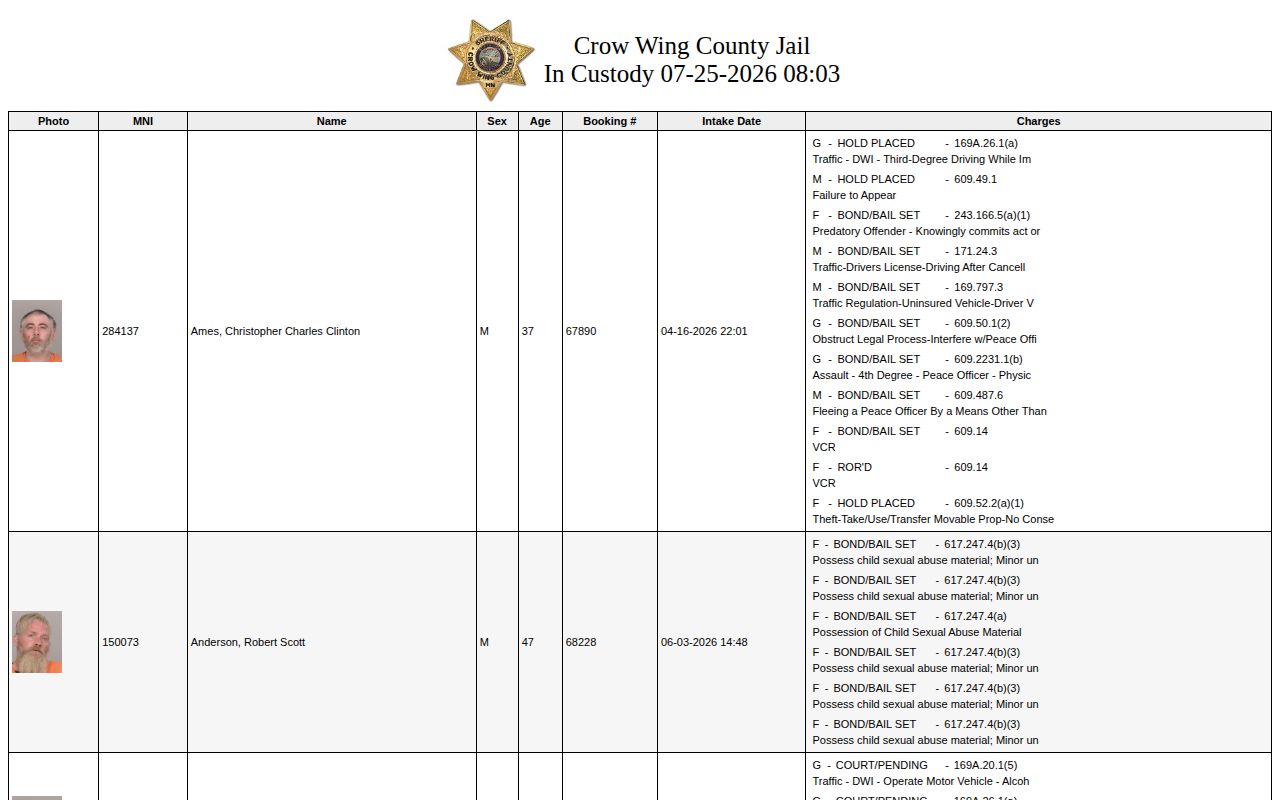
The screen supports a point-in-time custody finding. It cannot be turned into a three-day release archive by comparing intake dates or assuming when removed rows disappeared.
Reconcile Crow Wing Release Days
A sound 72-hour review builds a small timeline for the named booking. Mark the last roster time when the person was present, the first later time when the row was absent, any court order time, the VINE status retrieval time, and the actual jail release or transfer time when obtained. These entries may not match. The gap between them shows the limit of the public interfaces rather than a conflict that can be solved by guessing.
Suppose a release order is filed on Friday, the roster is checked Saturday, and a receiving-agency record appears Monday. Those facts do not show a Friday community release. Jail staff may have completed discharge later, another hold may have delayed movement, or the person may have transferred while offices were closed. Only the terminal jail data can define the local event. The receiving record then explains what happened next.
Three-day searches also cross calendar boundaries in ways that affect wording. “Over the weekend” may mean Friday evening through Monday morning. “Last three days” may mean three named dates. “Last 72 hours” is an exact rolling interval. Give the Jail Division the precise start and end so staff can identify an existing log, if one is maintained, or locate the named booking without having to infer the request.
Crow Wing County is also an ICE detention site. A person can leave a local criminal booking and remain in immigration custody, or may be held at the same physical jail under a different authority. A roster disappearance therefore needs a legal-custodian check, not just a building check. When the release disposition names ICE, use the ICE locator or ERO routing and preserve the exact transfer wording.
Request Crow Wing Release Dates
For a named booking, contact the Crow Wing County Jail Division at 313 Laurel Street in Brainerd or call 218-822-7050. The jail telephone is covered around the clock, while the public lobby is listed for weekday business hours. Ask whether the person is currently held and how to request public release or transfer data.
The county Data Practices process offers inspection, copies, or both. A narrow request should name the person, approximate intake period, and booking number or MNI when known. Ask for actual release date and time, legal basis or disposition, transfer date and time, receiving agency, and the booking photograph. Request existing records, not a new three-day report.
Inspection of public data is free. Copy costs can apply. No jail-specific fixed charge or guaranteed response time was located, so ask for an estimate before chargeable copying. If part of the record is withheld, ask the county to identify the statutory basis.
A request for all releases in a broad interval may depend on whether the jail already keeps a responsive log or export. Minnesota data rules do not require an agency to create new data or answer a research question. Asking whether an existing record covers the interval is accurate. For a single person, the named booking and requested fields give the county a clearer path to the stored record.
Read Crow Wing Release Outcomes
A release disposition tells what ended Crow Wing County Jail custody. Bond or release on conditions usually leaves a court case open. Time served means the local custodial term ended after applicable credit and deductions. A transfer means another authority received the person. Probation or state supervised release can continue in the community after physical custody ends.
| Record result | Next confirmation |
|---|---|
| Bond or conditions | Read the Crow Wing court case for terms and later events |
| Time served | Confirm the actual jail release time and any remaining supervision |
| Transferred to DOC | Search the Minnesota DOC Public Viewer after intake processing |
| Released to another county | Use that county’s jail or records office |
| Released to federal or ICE custody | Continue with BOP, federal court or USMS, or ICE ODLS as applicable |
VINE is a custody-change tool, not a browsable list of everyone released across three days. MCRO is a case-history source, not a release feed. The Minnesota DOC Public Viewer covers people within state corrections jurisdiction, not ordinary short local bookings. Each source answers one part of the question.
Identity must remain stable as the search moves among systems. An MNI belongs to the local jail system, a booking number belongs to one custody episode, a DOC offender ID belongs to the Minnesota corrections record, and a court case number belongs to one proceeding. Match name, age or birth information, and case facts before connecting results. Common names and multiple open cases can otherwise create a false three-day release finding.
Note: “Inactive” in an MCRO case search describes case status, not custody status, so include it without treating it as proof of release.